How Long Does Composite Fencing Last?
One of the most common questions buyers ask before choosing outdoor fencing is:
“How long does composite fencing actually last?”
The short answer:
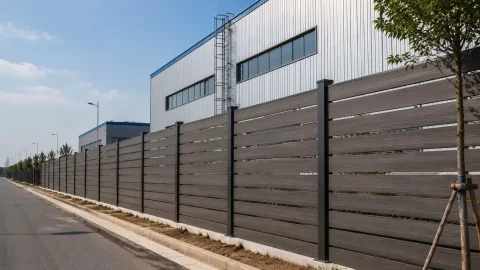
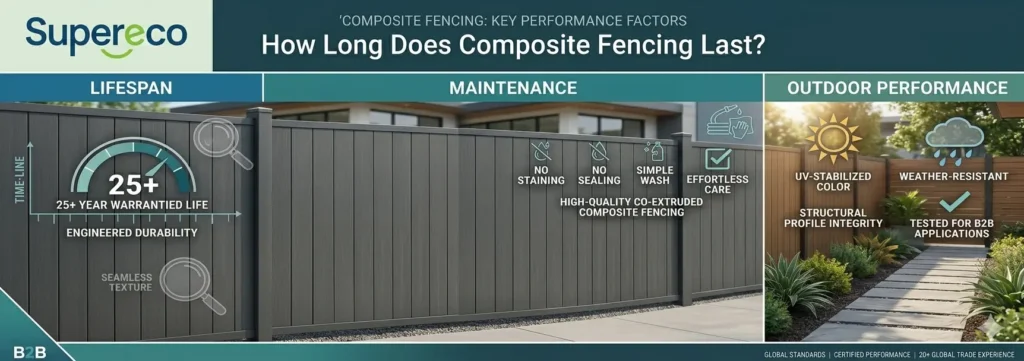
High-quality composite fencing typically lasts 20–30 years or more with minimal maintenance.
But the actual lifespan depends heavily on:
- raw material quality
- manufacturing standards
- UV resistance
- climate conditions
- installation quality
- long-term structural stability
This is why some fencing systems continue performing reliably for decades, while others begin fading, cracking, or deforming within only a few years.
For distributors, contractors, and developers, the lifespan difference is usually determined long before installation — during raw material selection, formulation control, and manufacturing.
What Determines the Lifespan of Composite Fencing?
Not all fencing systems are manufactured to the same standards.
Long-term outdoor durability depends on several critical factors.
Raw Material Quality
Raw material consistency is one of the biggest factors affecting outdoor performance.
Reliable WPC fencing manufacturers carefully control:
- HDPE quality
- wood fiber ratio
- UV stabilizers
- additives
- formulation balance
Low-quality products often use:
- contaminated recycled plastics
- unstable additives
- excessive filler content
These shortcuts may reduce production cost initially, but they often increase the risk of:
- premature fading
- brittleness
- cracking
- deformation
- structural instability
Many outdoor fencing failures are not immediately visible during installation or sampling.
Problems often appear after:
prolonged UV exposure
repeated moisture cycles
seasonal temperature changes
especially in:
- coastal regions
- tropical climates
- high-humidity environments
This is why experienced buyers focus more on formulation stability than sample appearance alone.
Co-Extrusion Technology Makes a Major Difference
Modern co extrusion composite fence systems generally provide better outdoor durability than traditional uncapped fencing.
The protective outer layer is designed to improve:
- UV resistance
- moisture protection
- stain resistance
- scratch resistance
- color stability
In high-UV or humid environments, this additional protection can significantly improve long-term outdoor performance.
However, not all co-extrusion systems perform equally.
Low-quality cap layers may eventually:
- peel
- crack
- fade unevenly
- separate from the core material
In large outdoor projects, UV stability problems often become visible only after 1–2 years of exposure.
This is why professional buyers usually request:
- weather-aging reports
- UV testing data
- outdoor project references
- cap layer specifications
before selecting a composite fencing supplier.
Climate Has a Direct Impact on Outdoor Lifespan
Outdoor fencing systems are constantly exposed to:
- sunlight
- moisture
- temperature fluctuation
- seasonal weather conditions
Traditional wood fencing naturally absorbs moisture and expands over time.
Composite fencing is engineered to improve dimensional stability, but climate still affects long-term performance.
In coastal and tropical markets, moisture-related deformation is one of the most common reasons for premature fencing replacement.
Meanwhile, strong UV exposure can gradually impact:
- color consistency
- surface appearance
- material flexibility
This is why reliable composite fence manufacturers typically conduct:
- UV resistance testing
- water absorption testing
- dimensional stability verification
- weather-aging simulation
before products are used in commercial outdoor applications.
For long-term projects, environmental stability is often more important than short-term material savings.
Installation Quality Also Affects Lifespan
Even high-quality fencing systems can fail prematurely if installation is incorrect.
Common installation problems include:
- insufficient expansion gaps
- weak post support
- improper drainage
- incompatible fastener systems
These issues may eventually lead to:
- panel movement
- structural instability
- premature deformation
Professional composite fencing wholesale suppliers usually provide:
- installation guidance
- matching accessories
- tested installation systems
- project-based recommendations
because long-term outdoor performance depends on both product quality and installation quality.
Does Composite Fencing Fade Over Time?
Yes — but the level of fading depends heavily on manufacturing quality.
Most modern composite fencing products experience slight natural color adjustment during the early stage of outdoor exposure.
High-quality systems generally stabilize afterward.
Low-grade products may continue:
- fading unevenly
- losing surface consistency
- developing visible discoloration
This is why UV-resistant cap technology has become increasingly important in modern outdoor fencing systems.
Does Composite Fencing Crack or Warp?
Under normal outdoor conditions, high-quality composite fencing is designed to resist:
- cracking
- warping
- splintering
However, low-quality products may still develop problems due to:
- unstable formulations
- poor extrusion control
- excessive filler materials
- weak structural density
For distributors and contractors, dimensional stability is often one of the most important indicators when evaluating a WPC fencing supplier.
Because structural problems usually become far more expensive after installation than during sourcing.
How Much Maintenance Does Composite Fencing Require?
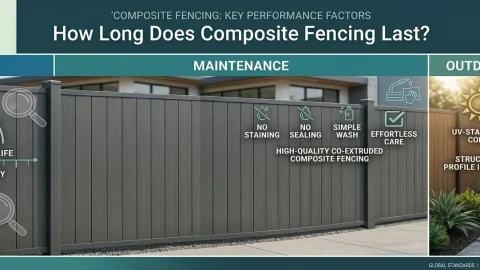
Compared with traditional wood fencing, composite fencing requires relatively little maintenance.
Basic maintenance usually includes:
- routine cleaning
- removing standing water
- periodic inspection of fasteners
- keeping drainage areas clear
Unlike wood fencing, composite systems generally do not require:
- painting
- sealing
- sanding
- anti-rot treatment
For commercial projects, reduced maintenance usually means:
- lower operating cost
- fewer after-sales issues
- reduced replacement frequency
- better long-term project value
This is one reason low-maintenance outdoor materials continue gaining popularity worldwide.
Composite Fencing vs Wood Fencing: Which Lasts Longer?
In most outdoor environments, modern composite fencing generally lasts longer than traditional wood fencing.
| Material | Typical Lifespan |
|---|---|
| Standard Wood Fencing | 8–15 Years |
| High-Quality Composite Fencing | 20–30+ Years |
Wood fencing is naturally more vulnerable to:
- moisture absorption
- cracking
- rot
- termite damage
- UV aging
Modern composite systems are engineered specifically to improve:
- weather resistance
- dimensional stability
- long-term outdoor durability
For commercial projects, lifecycle cost often matters far more than initial purchasing price.
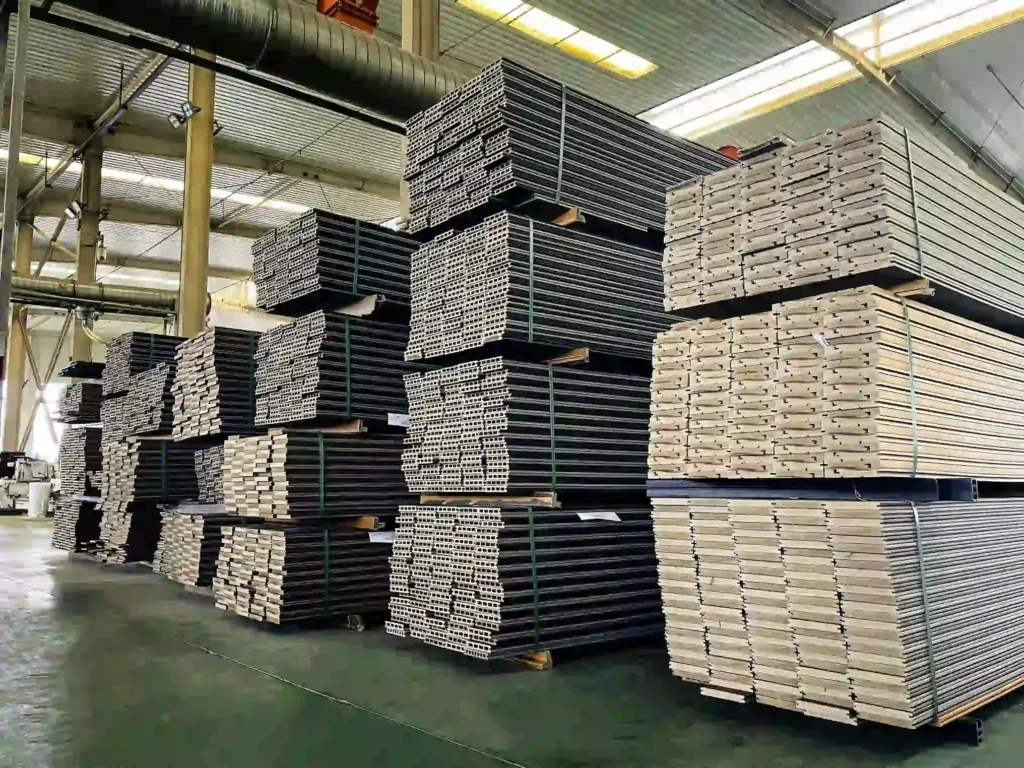
Why Global Sourcing Managers and Distributors Choose Supereco WPC
In the international B2B composite sector, initial sample appearance is secondary to mass-production consistency. For high-volume distributors and commercial contractors, Supereco WPC eliminates supply chain volatility through institutional-scale manufacturing and proven technical expertise.
Data-Driven Trust & Global Scale
Our authority in the wood-plastic composite (WPC) industry is backed by measurable operational excellence:
20+ Global Years of Experience: Decades of navigating international B2B compliance, logistics, and regional building codes.
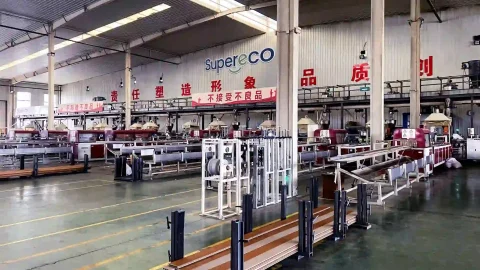
100+ Advanced Production Lines: Heavy-duty, automated infrastructure ensuring parallel processing and zero batch variation.
100,000+ Tons Annual Output: High-volume capacity that guarantees scalable bulk supply and long-term price stability.
20+ Technical Patents: Continuous R&D innovation in weatherproofing and material longevity.
70+ International Markets Reached: Formulations field-tested and proven in environmental extremes worldwide.
Technical Advantages & Ecosystem Consistency
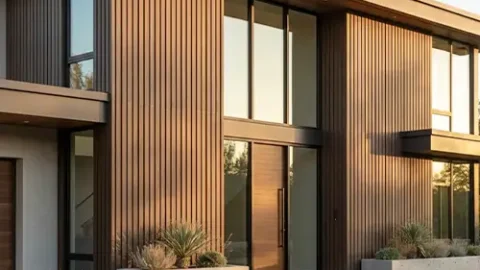
We provide a completely integrated, color-matched architectural ecosystem—including WPC fencing, co-extrusion composite fence systems, WPC decking, and wall cladding. Every production run supports predictable, long-term outdoor performance through rigorous manufacturing guardrails:
Advanced Extrusion Automation: Digitally controlled compounding eliminates human error, guaranteeing identical cross-sectional density and profile geometry.
Strict Raw Material Tracing: Zero-compromise vetting of recycled polymers and wood fibers to eliminate internal rot and excessive thermal expansion.
Accelerated Weather Testing: Continuous laboratory simulation for UV radiation and moisture absorption to ensure world-class color stability, moisture resistance, and structural durability.
Professional OEM/ODM Support: Tailored profile customizations and compliance mapping (CE, ASTM) to secure global distributors’ proprietary brand advantages.
Final Thoughts
So, how long does composite fencing last?
High-quality composite fencing can typically last 20–30 years or more with minimal maintenance.
But long-term outdoor performance depends heavily on:
- formulation stability
- manufacturing quality
- UV protection capability
- installation systems
- climate adaptability
For distributors, contractors, and developers, choosing a reliable composite fencing supplier is one of the most important factors in reducing:
- maintenance costs
- replacement frequency
- warranty risks
- long-term project issues
Because the real lifespan difference between fencing systems is usually determined long before installation — during manufacturing.
Looking for Reliable Composite Fencing Solutions? Request samples, technical specifications, or project consultation from Supereco for your next outdoor fencing project.